The Standard
Every FWG development follows the same disciplined path. Not because process is the goal, but because consistent rigour is what protects the quality of the outcome at every stage.
Residential development has a way of compressing important decisions into moments where there is little time to think. The best defence against that pressure is a process that has already thought through it.
FWG does not move quickly for the sake of movement. Each stage of a project receives the attention it requires. What we deliver to buyers is the result of deliberate decisions made across years, not weeks. Understanding that process is part of understanding what you are acquiring.
Site selection is where most residential development either earns its outcome or undermines it. FWG assesses a significant number of sites before proceeding on any one of them. That discipline is deliberate.
Our assessment framework covers zoning and planning intent, site orientation and solar access, flood, bushfire, and heritage overlays, council-specific planning constraints, neighbouring use and streetscape character, access, services, and infrastructure capacity, and long-term demographic trajectory for the locality.
A site that passes that assessment is then assessed on financial feasibility. Not the optimistic version. A realistic feasibility that accounts for contingency, market softening, and extended programme. Only when a site clears both filters does FWG proceed.
Our focus on Central Coast and Lake Macquarie council areas reflects years of accumulated knowledge about where the planning framework is permissive, where infrastructure is improving, and where buyer demand is sustained. That local depth informs every site decision we make.
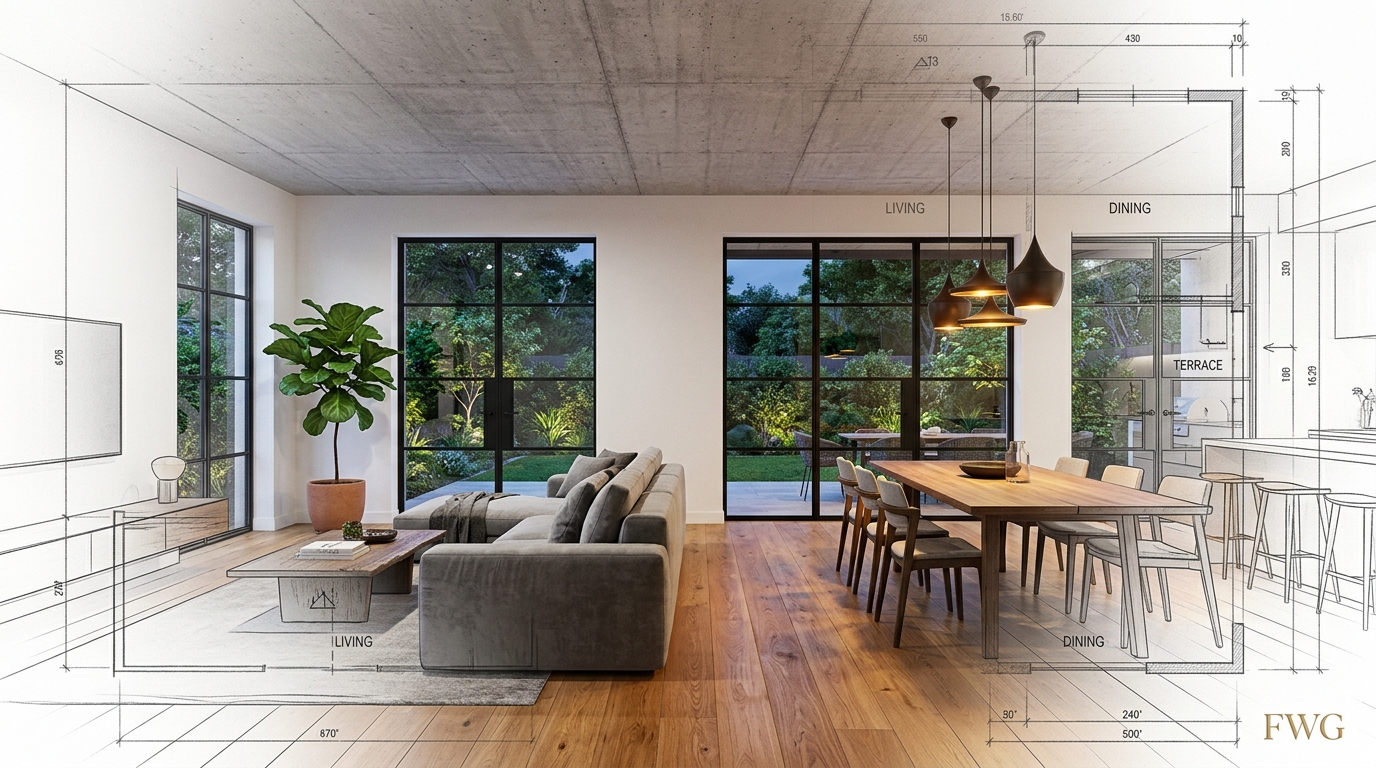
FWG brings an architectural approach shaped by restraint and longevity. The question we return to in every design conversation is simple: will this still feel right in fifteen years? Architecture that ages well tends not to chase trends. It focuses on proportion, natural light, material quality, and the practical logic of how people move through and live in a space.
Our design intent is French provincial in influence, pared back in execution. Rendered facades, considered fenestration, arched detailing where it serves the architecture rather than decorates it. Interiors that feel warm and complete, not staged.
Material selection is approached with the same rigour as site assessment. Finishes that perform over time, that weather with dignity, that do not require constant maintenance to maintain their character. The quality of a home is felt daily by the people who live in it. That is the standard we design to.
Design development is iterative and owner-involved. Stephen Pastor holds a strong view on proportion and livability, and that view is applied consistently across all FWG projects. The result is a coherence of outcome that carries across the portfolio.
Council approvals are one of the most time-consuming and risk-laden stages of any residential development. The outcomes depend heavily on how an application is prepared, how it addresses the specific requirements of the relevant environmental planning instrument, and how it is managed through the assessment process.
FWG's focus on Central Coast and Lake Macquarie council areas means we approach planning applications with detailed local knowledge. We understand what these councils look for, where they apply discretion, and how to structure an application that addresses their assessment criteria clearly and completely from the outset.
Our approach to approvals is to invest in the quality of the application up front rather than managing requests for information after lodgement. A well-prepared application, addressing likely council concerns before they are raised, is the most reliable path to timely determination.
We work with experienced planning consultants, surveyors, and specialist consultants as required, coordinating their inputs to ensure a coherent and complete submission. The planning process is managed as a project in itself, with clear milestones, responsibility allocation, and contingency for likely review periods.
FWG Projects, led by Timothy Walsh, manages construction delivery across all FWG developments. Timothy is a licensed builder with extensive experience across residential builds of comparable complexity and scope. His involvement is direct and continuous. Not advisory from a distance, but on-ground oversight with the authority to make decisions and hold trades accountable.
The gap between what is designed and what is built is where quality is most commonly lost in residential development. Closing that gap requires a project manager who understands both the architectural intent and the practical realities of construction sequencing, subcontractor management, and materials procurement.
Timothy's approach to construction management is defined by clear programming, transparent reporting, and structured quality checkpoints at each stage of the build. Progress is tracked against programme, variations are assessed and approved before they are executed, and quality is inspected against specification at each completion milestone.
FWG developments are not built to a minimum standard. The specification that is agreed at design stage is the specification that is delivered. That commitment is enforced through the construction management process, not just stated in a contract.
Handover is where many developers consider their obligation fulfilled. FWG takes a different view. The practical completion of a residence is the point at which a buyer's daily experience begins. How that transition is managed matters.
Our handover process begins well before practical completion. Pre-settlement inspections are structured, documented, and followed up with a clear defects resolution programme. Buyers receive a comprehensive orientation to their home, covering building systems, materials maintenance, and any items specific to the property.
Where defects arise post-settlement, they are addressed promptly and without dispute. Our reputation is built on individual projects. A home that is not right is a problem we take seriously and address directly.
The relationship with buyers does not end at handover. FWG is a small platform operating in a defined geography. The people who buy our developments are part of the same communities we operate in. That proximity creates accountability that no contract requires.
The FWG process is not complicated. But it is consistent. The same level of care that applies to site selection applies to handover. That consistency is what produces homes that endure.
Our current developments at Bonnells Bay demonstrate what this process delivers in built form. View the work in progress.